About the author

More posts by Moderator

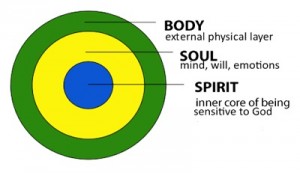 Last week, I presented an alternate view to the 3-part: body, soul, spirit division of the human person. My point was that the Bible uses “soul” and “spirit” synonymously. Because Bill Gothard uses the 3-part system as the basis for many of his teachings (if not the basis, then at least connected with). However, if a logical, biblical alternative can be presented, then it calls into question all of Bill’s teachings connected with the topic.
In this second article, my desire is to answer the most common Bible verses most used by trichotomists to build their case for the 3-part system.
“May the God of peace himself sanctify you wholly; and may your spirit and soul and body be kept sound and blameless at the coming of our Lord Jesus Christ” (1 Thess. 5:23).
“The word of God is living and active, sharper than any two-edged sword, piercing to the division of soul and spirit, of joints and marrow, and discerning the thoughts and intentions of the heart” (Heb. 4:12)
First, let me remind you that these two verses are the ONLY references to the “spirit” & “soul” being distinct. As presented in the last article, the normal usage of the two words is synonymous.
Second, in both verses, no functional definitions were given to distinguish between the two. What the Bible lacks, Bill Gothard supplies. Since the Bible doesn’t tell us what the difference between the words is, Bill decides to step in and create his own definitions: the “soul” is the mind, will, and emotions and the “spirit” is the part of us which relates to God.
Third, the reason these verses separate “spirit” and “soul” is not to emphasize their distinctiveness. In Heb. 4:12, the writer is trying to illustrate the piercing power of the word of God. He does this by stating that it can divide, “soul and spirit…joints and marrow”. The very point of this passage is that even though it is extremely difficult to separate “spirit” and “soul” or “joints” and “marrow”, the word of God has the ability to do so. If anything, this verse argues for the unity of the “spirit” and “soul” far more than the separateness of them.
In 1 Thess 5:23, Paul is trying stress the concept of entirety. He is praying that God sanctify the church in every area of its being. Paul expresses this by using several words which overlap (body, soul, & spirit). Is not thinking a function of both the body and the soul? Is worship not done with both our knees and our spirits? A similar expression is used is in Matt 12:30, “Love the Lord your God with all your heart and with all your soul and with all your mind and with all your strength”. Here, “spirit” and “body” is ignored entirely and other words are added, “heart” and “strength”. Surely, Jesus is not saying that we don’t have to love God with our “spirit” or “body”. Neither can our “heart” be readily separated from “soul”, “mind”, and “spirit”. The word usage is designed to communicate entirety. We are to love God with ALL we are and be sanctified in EVERY aspect of our lives.
Dangers:
My goal is not necessarily to trade trichotomy for dichotomy. In fact, It is important to stress the unity of our humanity. You cannot simply slice and dice one part from another. Our emotions (an immaterial aspect) can be affected by our hormones (a material aspect). Stress (immaterial) can have a negative impact upon our health (material). Physical exhaustion can impact our spiritual vitality (just ask Elijah, 1 Kings 19:1-5). Though we are both physical and non-physical, we are an essential unity which God designed uniquely in His creativity.
I have seen two major problems created by Gothard’s trichotomy: First, Gothard falls back upon Platonic dualism in his approach to sin and holiness. He argues that those things which appeal to our bodies are “sensual” (evil) while those things which appeal to our spirit are “holy”. (Gothard makes the case that since the rock beat appeals to the body, it is evil – using the same logic, I could argue that ice cream is a sin too, along with sex, medicine, and pizza!) See examples below from the Basic Seminar Textbook…
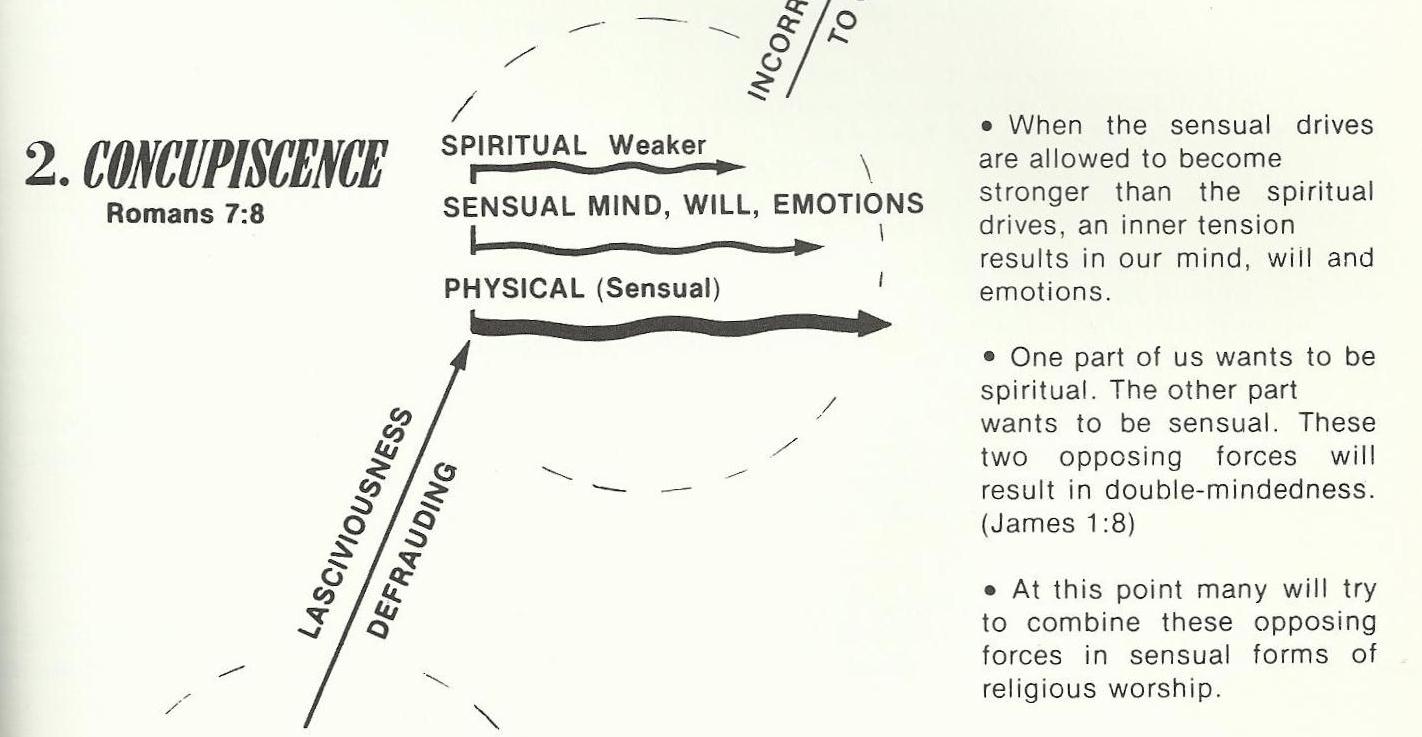
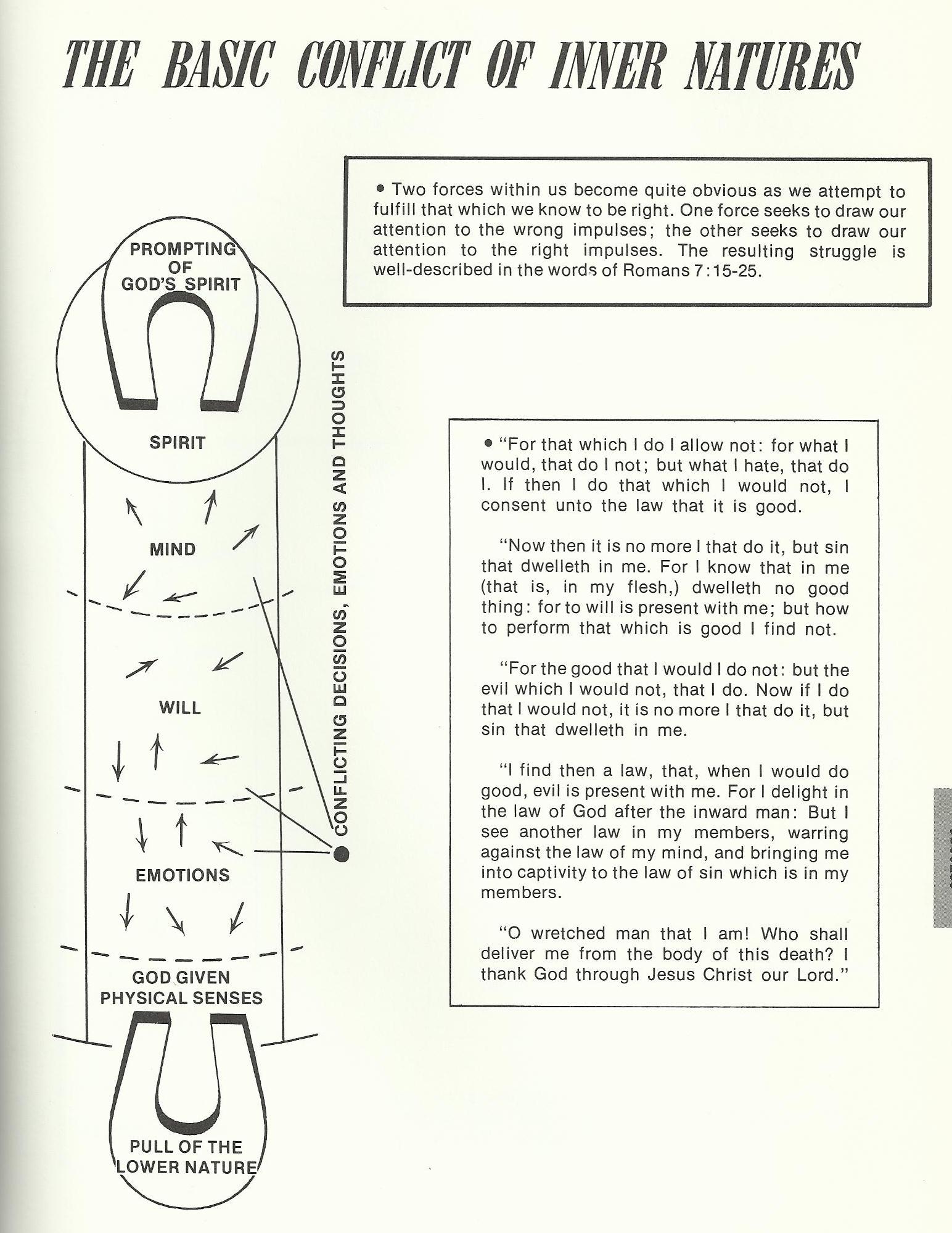
The illustrations above assume that the desires of the spirit are good while the desires of the body are evil. However, 2 Cor 7:1 states that the spirit can sin just as much as the body, ” let us purify ourselves from everything that contaminates body and spirit, perfecting holiness out of reverence for God.” Also, it is equally wrong to say that every physical desire is bad. The first chapter of Genesis states God made our material world “good”. Where then does evil come from? Surprisingly, evil does not come from the physical world, it comes from the spiritual world! Jesus said, “Don’t you see that nothing that enters a person from the outside can defile them… For it is from within, out of a person’s heart, that evil thoughts come—sexual immorality, theft, murder, adultery, greed, malice, deceit, lewdness, envy, slander, arrogance and folly.” (Mark 7:18-22)
Gothard’s understanding is actually rooted in Greek philosophy. Plato taught that the body was evil and the spirit was good. Thus, the more we could deny the body and focus on the “spiritual”, the better off we would be. In fact, the Greeks believed that when humans died, they were released from the “bondage” of the physical realm. However, Christianity teaches the opposite. The bible teaches that at the end of time, God will resurrect and transform our physical bodies and we will live with Him on a “new” physical heavens and earth. The Bible never paints the body as a problem to be rid of; it pictures the body as something worth rescuing from the curse of sin.
The second problem created by Gothard’s trichotomy is that he separates the soul (mind, will, emotions) from the spirit in interpreting scripture. He argues that the Bible is “spiritually” discerned. “Why is it important to read the Scriptures to an unborn child? The Scriptures are understood by spiritual perception. Therefore, even though the intellectual ability of an unborn child is not developed, the spiritual perception of that child is developed.” (Advanced Seminar Textbook p.310) Gothard uses his “spirit” as the sole means of interpreting many verses (And usually the result is that he misses the point of many passages entirely!) Look at what he says in Men’s Manual I (p. 80)…
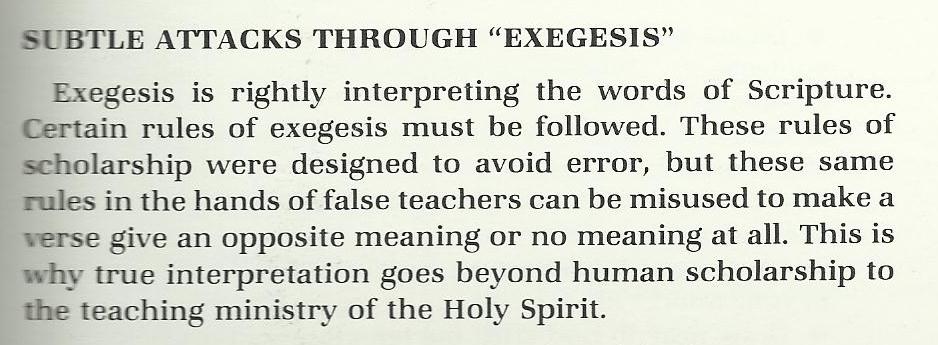
What this nonsense effectively does is give anyone permission to skip over logic, reason, and scholarship. Forget a commentary, try “What is ‘the Spirit’ telling your ‘spirit’?” The problem is that Gothard claims the ultimate authority is your “spirit” in interpreting scripture. But if someone is using bad exegesis, would it not be better to counter it with good exegesis? After all, how in the world are we to combat what the “Spirit” is telling someone else? There isn’t. Which is exactly what Gothard wants – so he can make the scripture say anything he chooses (While claiming the high ground of “the Spirit’s” interpretation).
Conclusion:
Believing that humans are made up of a body, soul, and spirit is NOT a sin. However, making up extra-biblical definitions for them and then building un-biblical teachings upon them IS. I would encourage you to reconsider the teachings which Gothard connects with his trichotomy views and reevaluate whether or not they are based upon a logical, contextual, interpretation of the scriptures, or is he doing what he often does – pulling them out of his hat.
Share this post:
Tweet this Share on Facebook Stumble it Share on Reddit Digg it Add to Delicious! Add to Technorati Add to Google Add to Myspace Subscribe to RSS


JM, you write: "The only point I can take issue ...
April 15, 2024 I enjoyed reading this. I honestly did. Picking ap ...
April 9, 2024 Is it really, Rob? Really? Is it okay to misrepres ...
April 5, 2024 Yes, I am aware Vlad Dracula is a national hero in ...
April 4, 2024 It's interesting that we think of the Impaler that ...
April 3, 2024 Well, the real Count Dracula of Transylvania was V ...
March 21, 2024 It was unsettling to me that you didn't seem to un ...
March 19, 2024 Dracula wouldn't be something I would have used to ...
March 13, 2024 I don't argue that. I was referring to this author ...
March 12, 2024 I had read "Let me be a Woman" long ago while at c ...
March 8, 2024 I definitely agree with that take. Again, I haven' ...
March 8, 2024 https://www.patheos.com/blogs/fleshofmyflesh/2024/ ...
March 6, 2024 I checked it this morning. It's been restored. ...
February 26, 2024 Go to Christianity Today and in their search, type ...
February 19, 2024 Hey. That link is dead. Not sure what happened, bu ...
February 19, 2024 https://www.christianitytoday.com/ct/2023/july-aug ...
February 16, 2024 I'm not sure why it is such a surprise that Eliot' ...
February 15, 2024 Check out the Bare Marriage website. Today's artic ...
February 14, 2024



So helpful - thank you!!
This is really good. I had not thought through all the ramifications of this. Even back in the day, though, I always thought it amusing how bad it was considered to ever study Greek philosophy (the only thing we needed to know about *those* guys was their sexual preferences to know it was all bad, bad, bad), when in fact much of Gothard's teaching reflects Greek philosophy unconsciously. Perhaps if he'd spent some time really studying it he would have seen the connection.
First, Gothard falls back upon Platonic dualism in his approach to sin and holiness. He argues that those things which appeal to our bodies are “sensual” (evil) while those things which appeal to our spirit are “holy”.
Well said. This is a dangerous error in Gothardism. The implications are huge. In the earliest days of the church it was not fashionable to speak about the physical body as a good thing. In our day, people are willing to believe that Jesus was human but not that he was God. But in those days, people seem more likely to accept that Jesus was God but not physically human. But "that which Christ has not assumed, he has not healed." Jesus assumed a physical body in order to redeem us as whole persons, body included.
Jesus' physical body was raised. Humans were created good and in God's image, body included. Again, the implications of these things are huge for how we think of physical pleasure and physical labor. Our spirits are not pure things imprisoned in corrupt bodies. Rather, our whole person, body, soul, spirit, mind, will, strength, emotions, heart - we are redeemed as whole persons and we are free to live to God as whole persons, whether we are kneeling in prayer, building a house, or enjoying a hot dog.
Back in 1984, an Old Testament professor, wrote that the week he attended a Basic Seminar was "one of the most difficult weeks" of his life. This is in his essay, "Issues of Concern."
A paragraph from that will illustrate one of the implications of Gothard's view of the body:
Given Gothard’s low view of the body and his repressed views of human sexuality, it is not surprising that he neglects entirely the Song of Solomon with its beautiful eroticism and its delight in human sexuality. For Gothard, the things done between a man and a woman are the secret things of Ephesians 5:12, a disgrace even to speak of such. Only on the basis of his own negative, programmatic approach to human sexuality would Ephesians 5:12 refer to the marriage bed. Serious exegesis matters little in such an approach.
This article was really helpful for me in articulating many of the problems I've seen with Gothard's view of the body. Interestingly, his thoughts play directly into the Gnostic form of beliefs, which beliefs were countered by the Council of Nicea in 325. Gosh, that's a long time for heresy to persist after being labeled as such.
1 Thes 5:23 and Heb 4:12 are not the only verses that distinguish spirit from soul in man.
What about the Song of Mary, Mary's Magnificat. Luke 1: 46-55. In verses 46-47, Mary said, “My soul magnifies the Lord, and my spirit rejoices in God my Saviour”
Roblyn
Roblyn, what a beautiful passage, and timely!
Many people would suggest that rather than making a distinction between soul and spirit, this is an example of parallelism in Hebrew poetry. By restating the same idea in slightly different terms, Mary is blending soul and spirit together rather than separating them out.
I googled for parallelism and this link seems good: http://www.ancient-hebrew.org/23_parallel.html
For example, "Your word is a lamp to my feet and a light to my path" is restating the same idea poetically, not making a careful distinction between lamp to feet and light to path. Parallelism shows up constantly, all throughout the Psalms and other poetic passages in Scripture.
The Magnificat has both repetition and contrast:
(repitition)
he hath scattered the proud in the conceit of their heart.
He hath put down the mighty from their seat,
(contrast)
He hath filled the hungry with good things;
and the rich he hath sent empty away.
"Gothard’s understanding is actually rooted in Greek philosophy. Plato taught that the body was evil and the spirit was good."
Just before being presented with Mr Gothard's teachings on body, soul, and spirit, I had taken a philosophy class. There seemed to be a distinct similarity, so I am very glad that others saw the same way. Thankfully I also had Dr Grudem's Systematic Theology under my belt by that point as well, and his careful explanations directly out of the text of Scripture greatly helped my understanding.
Can you link Part One?
Cynthia, This looks like Part One: https://www.recoveringgrace.org/2011/12/body-soul-spirit-an-alternate-view/
You said:
"What this nonsense effectively does is give anyone permission to skip over logic, reason, and scholarship. Forget a commentary, try “What is ‘the Spirit’ telling your ‘spirit’?” The problem is that Gothard claims the ultimate authority is your “spirit” in interpreting scripture. But if someone is using bad exegesis, would it not be better to counter it with good exegesis? After all, how in the world are we to combat what the “Spirit” is telling someone else? There isn’t. Which is exactly what Gothard wants – so he can make the scripture say anything he chooses (While claiming the high ground of “the Spirit’s” interpretation).
Are you saying that you understand EVERYTHING in the bible?
If you don't understand everything, then...what do you do when you run into something you don't understand? Do you ask someone who is smarter than you?
"If you don't understand everything, then...what do you do when you run into something you don't understand? Do you ask someone who is smarter than you?"
You ask several somebodies who are smarter than you, read commentaries both written today and in ages past, think lots about the answers you are given and pray for guidance. Sometimes it may take years to get a good answer. Scripture says there is wisdom in a MULTITUDE of counselors.
How would that make a "smarter than me" person any different from what this author is accusing Bill Gothard of doing?
And, isn't my relationship with God enough, that I can hear from Him? How do I determine that a "smarter than me" person has properly interpreted scripture?
@Mindy: you wrote: And, isn't my relationship with God enough, that I can hear from Him?
in a word, well two words: not always
there is no need to be on such an island. yes, bad things can happen when we trust the wrong pastor, teacher, doctor, oncologist, pilot, etx.
but worse things usually happen when we default to "just me and Jesus and the Holy Spirit" this is not what GOD had in mind (neither did he have Bill's methods in mind either, of course) Some mistrust of leaders and teachers is understandable, for those who are still nursing 3rd degree burns, but following our own counsel as our main channel of insight is a sure way to end up in some kind of spiritual ditch.
Overdendence on a single source (Bill is a 'good' example of this) is a terrible idea, using multiple sources who have proven trustworthy over the years: that is waging war with many (good) counselors. hope this helps
Yes, I ask around when I don't understand things. However, I am certainly not surveying to see what a majority thinks, rather I am looking for that spiritual answer that rings true with my spirit and is in line with God's word. So my point was that, a smarter person than me will still never be as smart as God. We need His Spirit, our teacher!
You make me think of a time a few years back when someone came to me and asked me to mentor them. I told them I wouldn't mentor them, but I would be a friend. We could share books, bounce ideas off each other, pray together, maybe work together serving others, or whatever might be needed just to know someone was there to love, laugh, cry with. Years passed and she let me know she had thought she needed a mentor, but what she really needed was someone who loved sharing life. Smarter isn't always what is needed.
Nancy2: that is excellent testimony. We all need several mentors, because we all have 'gaps' and deficiencies. Your emphasis on 'friend' kept you on the same level (neither above , nor below) as the one who approached you. We need more of this way of thinking, even when one of the two is more mature in some areas. We all have one Teacher, Priest, and Father.
greg r, "neither above , nor below" was the definition of respect my husband continued to give our son since he was six. He is 32 now. I love both their respectful approaches to others and themselves. Both are good men. That definition carries a lot of possibilities.
@Nancy2: that simple phrase is SOOOO many X better than the garbage taught on 'authority' that is so prevalent (NOT just limited to BG)...there is a weirdness to this that in pandemic in protestant circles: it helps to know that , although dearly loved by GOD as unique, we are all dispensable in a sense... none of us are THE key guy/girl
"it helps to know that , although dearly loved by GOD as unique, we are all dispensable in a sense... none of us are THE key guy/girl"
This is where the meaning of work is important to me. God calls us to an opportunity. When we yield to that opportunity we are accepting an invitation to enjoy His work. If we can't accept that opportunity (Not through any fault, sometimes life just happens.) He moves His plan forward in another way. When it really gets exciting is when so many are called to one opportunity and all seem to fit what is needed perfectly in spite of life's uncertainty.
There was a job I got to be a part of just like that. A minister was coming into the Gulf Coast from the Northwest with a small group of college students to volunteer rebuilding a 142 year old church that had been destroyed by a hurricane. The leader's father had a stroke as the group was getting ready to fly in the next day. I got a call that I needed to lead the group and make their opportunity fruitful. I looked at my hammer drill, 400 bolts, and my sledge hammer then sat in the floor, prayed, and cried because it wouldn't be enough work for 15 intelligent young adults to feel fruitful. They had saved for months and sacrificed to be there. I had nothing big enough to show them I valued their sacrifice.
Said "Amen", got off the floor, dried my tears and the phone rang. Apparently a master carpenter from Illinois couldn't sleep that night and wanted to know if there were any strong bodies willing to work on the church for the next ten days. He had two other master carpenters who would be coming with him. They arrived three hours before the students.
He also sent us a van of 12/12 year old girls from Ft Worth going on a Spring Break Retreat and had 3 hours to kill. In that 3 hours they carried all our lumber and cans of water from across the street and staged it around the pilings which made everything go faster for the students and carpenters.
When one plan fell through God in His goodness moved to His secret plan that He was planning to unveil just to thrill us all. The perfect team with architectural students from the Northwest joined together with master carpenters from Illinois, and pre-teen girls from Ft Worth all being lead by the Holy Spirit for His purpose. Nothing we could have planned would have ever matched what God did that 10 days in the lives of everyone, including the church members.
In the end we gloried and giggled over watching the Hand of God moving with such Power, Mercy, and Grace to show love to people who had lost so much. Every day was a reward as we witnessed God at work. Every moment was a thrill to see Our Father taking care of the details as He moved us. No "It guy/gal" was needed.
Yes we are all equally love, yet dispensable. The only thing that is indispensable is Knowing Him.
I enjoyed this article.
I have always believed there was nothing wrong with being sensual (enjoying one's senses). I think of how God placed Adam and Eve in beauty, and how He desired them to discover pleasure in His creation. Feelings from the warmth of the sun, to a cool breeze, to the smell of ligustrum, to the sight of the sun shimmering across a lake, to music for dancing, or to the taste of honey brings about thanksgiving to a Heavenly Creator for creating us with different ways to enjoy what He has created.
It is sad when someone sets up extra rules that eventually realign a person's focus on fearing sin instead of loving beauty. Once the person's focus has been realigned their fear places sin always before them. It seems that the new focus would make it harder to resist temptation.
Bill Gothard clearly used Watchman Nee who taught this in his book, "The Spiritual Man".
I remember thinking this when I attended IBYC back in 1979, because I was reading his books at that time. I am surprised there isn't more on this connection between the two on this web site.
In my opinion, as the "TRICHOTOMY / TRIPARTITE THEOLOGY" is based on (New Body; Soul and Spirit) in {Ezekiel 36:26; 1 Thessalonica 5:23 & Hebrew 4:12} I strongly support it. As we all know, "NON-CHRISTIANS" are of the opinion regarding "BODY & SOUL" or DICHOTOMY / DIPARTITE THEOLOGY ALONE. But, they do nor believe in "SPIRITUAL BIRTH". Because, they do not know what the SPIRIT EXACTLY IS!!! What the "DICHOTOMY / DIPARTITE THEOLOGIANS" are lacking is: (i) SPIRITUAL BIRTH / BORN FROM ABOVE. (ii) Ne Body; New Soul; New Spirit to be given to GOD'D people. (Ezekiel 36:26) Therefore, "TRICHOTOMY / TRIPARTITE THEOLOGY" should be our teaching if we are to be able to worh meaningfully for GOD>